|
|
|
The transfer function of the closed-loop system is:
|
|
Gз = |
1.4 / (1 + 0.03p)2 |
= |
1.4 |
≈ |
1.4 |
|
1 +
1.4 / (1 + 0.03p)2 |
1 +
p·0.06 + p2·0.0009 + 1.4 |
2.4 + p·0.06 |
|
|
= |
1.4 |
= |
23.3 |
|
0.06 · (p +
2.4/0.06) |
p + 40 |
|
|
Analytical Justification of Simplification: The second-order term p2 *
0.0009 in the characteristic denominator represents high-frequency
parasitic dynamics originating from the thyristor filter loop. At the
dominant transient timescale, its numeric weight is negligible compared
to the damping component (p * 0.06) and the static gain baseline (2.4).
Neglecting this parameter reduces the closed-loop system model to a
robust first-order transfer function, Gз = 23.3 / (p + 40), providing an
elegant and physically accurate mathematical framework for evaluating
the step response ht without inducing artificial numerical oscillations. |
|
:
The Laplace transform image for the transient response of the
closed-loop system under the reference excitation
XT(p) = 1/p is:
|
|
|
|
FT(p) = |
1 |
· |
23.3 |
= |
C1 |
+ |
C2 |
|
p |
p + 40 |
p |
p + 40 |
|
|
C1 = 23.3 / 40 = 0.58
C2 = 23.3 / –40 = –0.58
|
|
Applying the inverse Laplace transform, we obtain the original
expression F(p) |
|
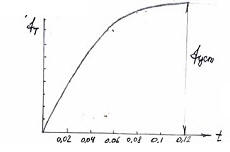
hт = 0.58 – 0.58·e–40t = 0.58 · (1 – e–40t)
|
|
The unit step response function of the system for a unit step
reference input command is shown in Fig. 12. |
|
 |